Learn about bitcoin by using bitcoin.
LiveWallet is a set of Elixir Livebook notebooks that together form a working bitcoin wallet. Open them in Livebook to explore keys, addresses, and transactions through code you can run and change.
Get started in three steps
-
Install Livebook (opens in a new tab)
Livebook is a desktop app for Mac, Windows and Linux. Download it once.
-
Run LiveWallet in Livebook
Opens the start page in the Livebook you just installed.
-
Follow the map
The start page draws the notebooks as a map. Run each one from the top, on testnet, where the coins have no value.
From your first bitcoin transaction
Start with a wallet, watch a payment arrive, then build and send a transaction yourself. Each notebook covers one concept, and the notebooks are grouped into tracks. Each track adds a layer to the one before it: keys, then transactions, then the things people build on top of them.
What you will learn
- Wallets do not hold coins; they hold keys.
- One seed phrase generates unlimited keys, deterministically.
- An address is a hash of a public key, not the key itself.
- A transaction is inputs that unlock earlier outputs, and outputs that lock value to new scripts.
- The fee is whatever the outputs do not claim.
- Anyone can verify any transaction, and you did.
- Keys can be shared, split and time-locked, and a transaction can carry data as well as value.
-
Setup
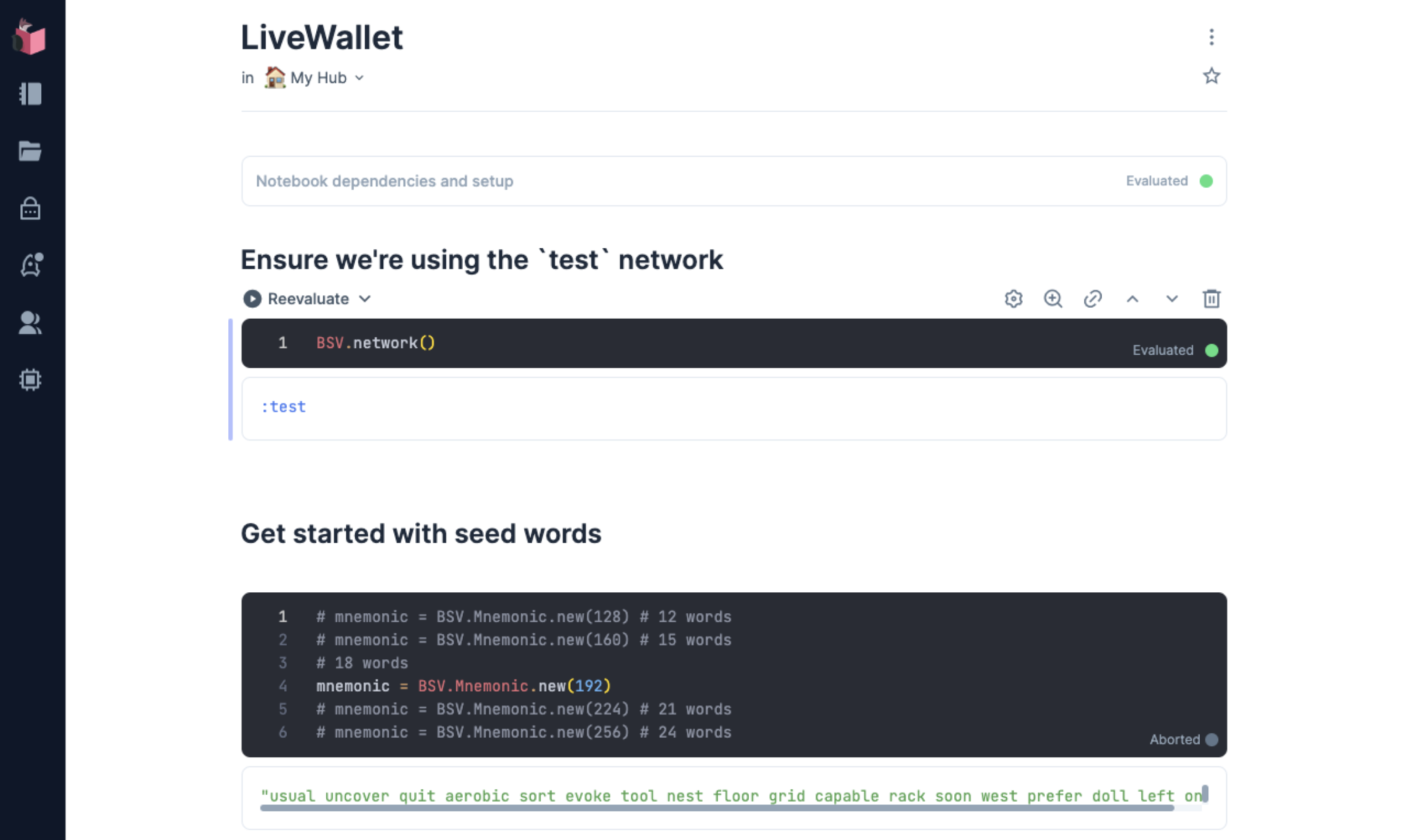
Open your learning workspace
Livebook is a desktop app for Mac, Windows and Linux. Download it once, then use Run in Livebook above to open LiveWallet.
Every notebook starts on testnet, where the coins have no value. Mainnet is an explicit opt-in: set a Livebook secret named
LB_NETWORKtomain. LiveWallet is experimental software that handles real keys; run it on your own machine and keep amounts under 1 USD.There is no numbered order. Each notebook says at the top what to do before it, works on its own, and ends with a Review cell that prints
PASS. -
Wallet keys
A wallet is a seed phrase and the keys it derives
You learn what a seed phrase, a seed, an extended key, a derivation path and an address are, by making each one. Then how far a key can be shared: a public key, a watch-only key, a key that never touches the network.
- Seed and Wallet: generate a seed phrase and turn it into a wallet.
- Keys and Addresses: derive many keys from one seed and make one reachable.
- Mnemonic and Derivation: passphrases, hardened paths, watch-only keys.
- Key Hierarchy: diagrams of what each layer of key can and cannot do.
-
Transactions value
A transaction unlocks earlier outputs and locks new ones
You learn what a UTXO, a txid, a confirmation and a fee are, by receiving bitcoin and reading it back from the chain. Then you build a transaction by hand: locking script, unlocking script, signature, change, a memo in an OP_RETURN, and a broadcast. Then a transaction that cannot be mined until a block height you choose.
- Receive Bitcoin: watch value arrive at an address you control.
- Verify On-Chain: read a transaction's inputs and outputs from the API.
- Send a Transaction: build, sign and broadcast by hand.
- Order Lock: a transaction that cannot be mined until a chosen block height.
-
Tools reading the chain
The chain is public data you can query
Not lessons, but utilities built from the pieces above. Point them at addresses and transactions you care about.
- Address Balance Viewer: watch many addresses at once.
- ML on Chain Data: a machine-learning smart cell, to be pointed at on-chain text.
-
Governance shared control
More than one key, more than one person
You learn what a multisig script and a partially signed transaction are, by running a signing ceremony. Then what it takes for a wallet to be a function: a watch-only key, an idempotent signer, and nothing kept between calls.
- Multisig Ceremony: two of three keys, held by three people, spend together.
- Serverless Wallet: a wallet shaped like a function.
-
Tokens planned
A satoshi can carry meaning as well as value
Create, read, transfer and burn, applied to inscriptions, on-chain posts, and assets held by old keys. Not yet written.
What will you build next?
At this point, you'll have crafted a bitcoin transaction from scratch, and used the bitcoin public ledger as an information and value network.
Go forth and discover new uses of bitcoin! 💫
Learn Bitcoin by using bitcoin
The companion book covers the why. What bitcoin is, how a wallet works, and what a transaction is made of, in a short illustrated handbook.
The last step in the tutorial has you send a transaction. Here is somewhere to send it.
Three ways to support LiveWallet, from free to a few thousand satoshis.
-
Share it with a bitcoin-curious friend.
-
Open an issue with feedback or questions.
-
Send your first transaction here. The last step in the tutorial has you build a transaction by hand. This address is a good place to send it. Anything you write in the memo stays on chain. A few thousand satoshis is plenty.